Knowledge Center
From Reactive to Predictive: How Real-Time Data Is Reshaping Water Treatment
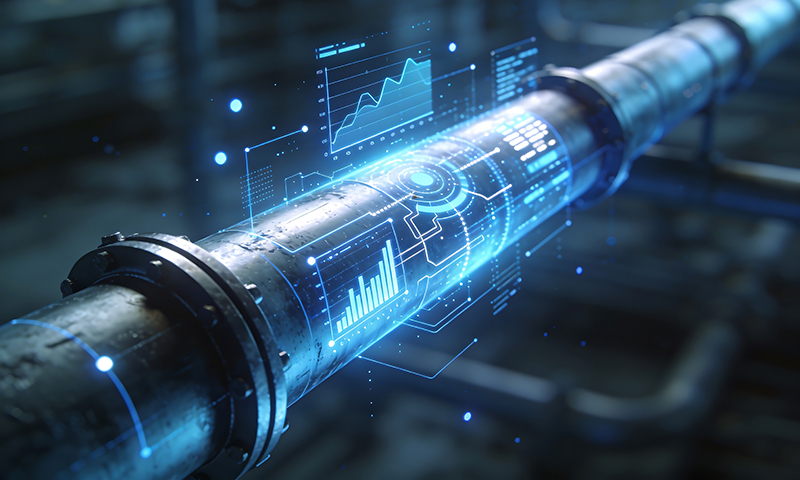
For decades, water treatment ran on a simple rhythm: pull a sample, run it through the lab, wait for results, then adjust. Operators tracked parameters like pH, hardness, inhibitor levels, disinfectants and turbidity by hand, often on a schedule measured in hours or days rather than seconds. These are referred to as the “Pinks and Blues.” That approach worked, but it left plants perpetually one step behind whatever was actually happening in the water.
That’s changing fast. The industry is shifting from manual testing and after-the-fact correction to continuous sensor monitoring paired with AI-driven control; catching problems as they form instead of after they’ve already cost money or capacity.
The Old Way: Testing, Then Reacting
Grab samples and periodic lab checks meant a plant could go a full shift, or longer, without knowing that scaling, fouling, or chemical drift had already started. Softeners, reverse osmosis systems, and heat exchangers would run inefficiently, or fail outright, before anyone caught the trend on a chart. Maintenance followed the same pattern: fix it when it breaks, not before.
Real-Time Sensors Close the Gap
Advances in sensor technology have allowed for continuous monitoring for many of the same parameters, the “pinks and blues,” plant personnel would test once a day, week or month. That constant data stream feeds directly into control systems, so adjustments happen in real time rather than after the operator tests or the next scheduled water treater check-in. In addition, immediate notifications of any upset conditions, unusual trends, or alarms are sent to plant personnel and the water treater. This follows what’s already standard in other parts of a plant, where heat, speed, pressure, and vibration are monitored continuously to keep equipment running at peak efficiency, water quality control is simply catching up to that model.
Where AI Fits In
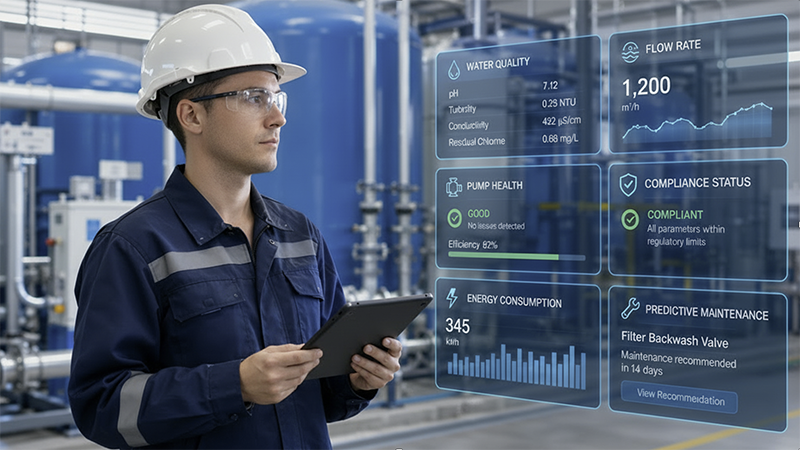
Sensor data alone tells you what’s happening now. AI’s contribution is anticipating what happens next. A practical example: if a cooling tower’s water temperature climbs above normal saturation levels, an AI-driven system can proactively adjust the control setpoint before scale has a chance to form on a heat exchanger, protecting efficiency instead of restoring it after the fact.
The same logic applies to chemical dosing. Rather than dosing on a fixed schedule, AI systems can adjust dosages based on live influent conditions, cutting chemical costs while keeping treated water consistently within spec. Predictive models trained on historical and real-time data can also forecast contaminant spikes tied to seasonal patterns, industrial discharge cycles, or weather events, giving operators lead time to adjust before the problem reaches the plant.
Predictive Maintenance: The Other Half of the Equation
Water quality isn’t the only thing benefiting from this shift, so is the equipment that produces it. Softeners, RO systems, pumps, and filters all generate real-time signals (vibration, energy draw, differential pressure) that can flag developing problems well before a breakdown. Facilities using this kind of continuous condition monitoring have been able to shift from reactive “run to fail” maintenance toward scheduled repairs during planned downtime, reducing both unplanned outages and long-term equipment wear.
A useful early indicator is energy consumption: a pump or blower drawing more power than its baseline is often the first sign something is degrading, well before vibration or output changes become obvious. Remote condition monitoring platforms use exactly this signal to flag issues in equipment that’s hard to physically inspect on a regular basis.
| Reactive Approach | Predictive Approach | |
| Data timing | Periodic samples/lab tests | Continuous real-time sensing |
| Chemical dosing | Fixed schedule | Adjusted to live conditions |
| Equipment care | Fix after failure | Address before failure |
| Cost pattern | Emergency repairs, downtime | Planned maintenance windows |
The Numbers Back the Shift
This isn’t a niche trend, it’s where investment is flowing. The global water treatment market is projected to grow from roughly $58 billion in 2023 to $100 billion by 2033, a 5.5% annual growth rate, with membrane-based systems already accounting for the largest share of installed technology. Machine learning applications specifically aimed at monitoring and optimizing treatment plants have shown measurable success in predicting system failures and improving overall performance.
What This Means for Operators
The practical upside isn’t abstract. Modern remote controllers now let operators monitor and adjust boilers, cooling towers, pretreatment, and wastewater equipment from a single interface, tracking water, gas, and electrical usage, logging data for food-safety and discharge permit compliance, and fine-tuning chemical dosing without walking the plant floor. That combination of real-time visibility and automated adjustment is what turns water treatment from a series of scheduled interventions into a continuously self-correcting system. The plants adopting this model first aren’t necessarily the biggest ones, they’re the ones treating sensor data and predictive control as infrastructure rather than an add-on.
Operators, water treatment professionals, and company leaders all share a common goal: reduce risk and increase profitability. By implementing sensor technology, capturing real-time data, and leveraging the power of AI, water treatment is moving from a reactive approach to a predictive one. The result is greater visibility, smarter decision-making, fewer surprises, and a more efficient and reliable water treatment program.

Rob Pierick
Senior Territory Manager
Rob Pierick has worked for Watertech of America for over 20 years and has experience providing industrial water treatment solutions for boiler, cooling, wastewater applications, and healthcare water management, including water testing, Legionella testing and remediation. Rob is a Certified Water Technologist (CWT) through the Association of Water Technologies. The CWT designation involves rigorous testing, peer review, and an ethics declaration. It must be renewed every five years to maintain this designation. Rob holds a BS from the University of Wisconsin Platteville.

Let’s start with your system.
Because every facility is different, our best insights come from an on-site evaluation. Click below to request a site survey — one of our Technical Engineers will reach out to schedule a visit.