Knowledge Center
Closed Loop Treatments
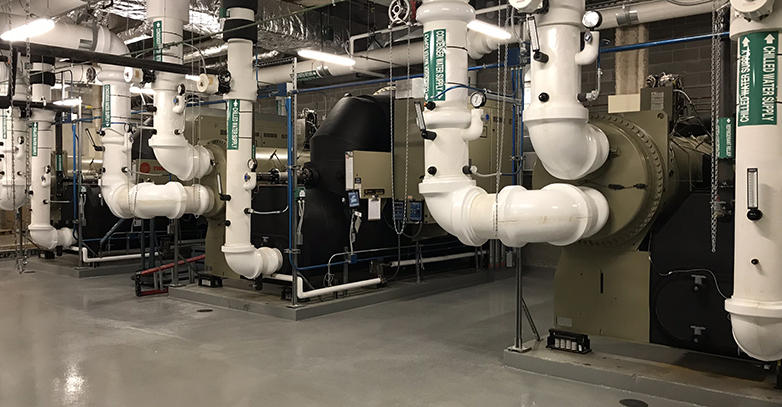
Closed loop water systems, chilled water loops, hot water heating systems, process cooling loops, and glycol systems, are often the most neglected water systems in a facility. Because they do not consume large volumes of water the way open cooling towers or boilers do, and because corrosion damage is not always immediately visible, they can deteriorate significantly before problems are noticed.
What Makes Closed Loops Different
In an open system like a cooling tower, water evaporates, blows down, and is continuously replaced with fresh makeup water. Chemistry concentration, microbial populations, and corrosion rates are managed through this constant turnover in addition to chemical treatment.
In a closed loop, water cycles continuously without significant losses or additions. This creates a fundamentally different dynamic:
- The same water remains in the system for months or years, allowing corrosion products, treatment residuals, and biological contamination to accumulate
- Water chemistry changes are slow, so problems develop gradually and may not trigger obvious symptoms until they are well advanced
- There are no routine makeup water additions to dilute contamination or replenish treatment chemistry that has been consumed
- System leaks, even minor ones, that bring in oxygen or allow treatment chemistry to escape can significantly alter the system chemistry over time
When closed loops fail, the consequences are significant: glycol system leaks can contaminate products in process applications, corroded chilled water piping causes expensive building damage, and plugged coils reduce system capacity and comfort in HVAC applications.
Corrosion in Closed Loops
Closed loop systems contain mixed metallurgy in almost every installation, steel piping, copper coils, brass fittings, aluminum components, and cast iron pump housings. Managing corrosion in this environment requires inhibitors that protect all these metals simultaneously.
The primary corrosion mechanisms in closed loops are:
- Oxygen corrosion: Dissolved oxygen enters the system during filling, through minor leaks, through expansion tank connections, and through pump packing. Even at low concentrations, oxygen drives aggressive pitting in steel and selective dezincification in brass.
- Galvanic corrosion: Dissimilar metals in electrical contact through the water accelerate corrosion of the less noble metal. Steel corrodes preferentially in contact with copper; aluminum corrodes preferentially in contact with steel or copper.
- Erosion corrosion: High-velocity water, particularly at pump impellers, pipe elbows, and control valves, strips protective films from metal surfaces and increases metal loss rates.
- Microbiologically influenced corrosion (MIC): Even in closed loops, microorganisms can establish biofilm communities that create localized corrosive conditions beneath the film. MIC is particularly aggressive and can cause deep pitting in relatively short timeframes.
Closed Loop Inhibitor Chemistry
Molybdate-Based Programs
Sodium molybdate is a widely used closed loop corrosion inhibitor that forms a protective film on steel surfaces through an anodic passivation mechanism. It is environmentally preferable to nitrite-based programs in many jurisdictions and performs well across a broad pH range. Molybdate is typically combined with azole compounds (benzotriazole or tolyltriazole) for copper protection and polymers for dispersion. Typical target concentrations are 100 to 300 ppm as molybdate.
Nitrite-Based Programs
Sodium nitrite is an effective anodic inhibitor for steel in closed loop systems. It is economical and provides good protection when maintained at adequate concentrations (typically 700 to 1,000 ppm as nitrite for systems without glycol; higher in glycol systems). However, nitrite has two significant drawbacks: it can biodegrade, providing a carbon and nitrogen source for bacteria; and it contributes to the formation of nitrosamines in certain chemical combinations, raising environmental and handling concerns. Glycol systems with nitrite require particular attention to biocide treatment to prevent nitrite depletion by bacteria.
Azole Compounds for Copper Protection
Benzotriazole (BZT) and tolyltriazole (TTA) form a stable, monomolecular protective film on copper and copper alloy surfaces that inhibits both general corrosion and galvanic attack. They are standard components of closed loop programs in any system containing copper. Typical target concentrations are 10 to 50 ppm, depending on the amount of copper in the system.
pH Control
Maintaining closed loop pH in the 8.0 to 10.0 range (the specific target depends on system metallurgy) significantly reduces corrosion rates for steel and cast iron while being compatible with copper protection by azoles. Systems with significant aluminum content require a lower pH target, typically 7.0 to 8.5, because aluminum corrodes rapidly above pH 8.5 to 9.0.
Glycol Systems
Many closed loop systems use ethylene glycol or propylene glycol for freeze protection or process temperature control. Glycol does not inherently protect against corrosion and in fact can accelerate it if the glycol has degraded. Glycol oxidizes over time to form glycolic acid and other organic acids, which depress system pH and drive corrosion.
Key considerations for glycol systems:
- Glycol concentration should be maintained at the level required for the design freeze point, verified by refractometer measurement
- pH should be monitored regularly, pH below 7.0 in a glycol system indicates glycol degradation and requires immediate attention
- Inhibitor packages in glycol solutions deplete over time and must be replenished; testing for inhibitor residuals is essential, not optional
- Degraded glycol with low pH and depleted inhibitors should be replaced rather than treated, attempting to restore heavily degraded glycol with chemistry additions is rarely cost-effective
Propylene glycol is preferred in food and beverage applications and anywhere that system leakage could contact consumable products, due to its lower toxicity compared to ethylene glycol.
Biological Control
Microbiological contamination in closed loops is often underestimated. Closed loop systems are not sterile environments, bacteria enter during system filling, maintenance activities, and through makeup water additions. In the absence of adequate treatment, bacteria establish biofilms on internal surfaces that create zones of localized corrosion and reduce flow.
Biocide treatment for closed loops typically involves periodic slug dosing with a non-oxidizing biocide (such as DBNPA, glutaraldehyde, or isothiazoline compounds) rather than the continuous oxidizing biocide treatment used in open cooling water systems. The frequency and product selection depend on the results of quarterly microbiological testing.
Monitoring and Service
Closed loop systems require less frequent service than open systems but should not be ignored between service visits. A basic monitoring program includes:
- Quarterly water analysis: pH, inhibitor residuals (molybdate or nitrite), azole residuals, copper, iron, total dissolved solids, and microbiological counts
- Annual glycol concentration and condition check (if applicable)
- Annual system inspection: air vents, expansion tanks, strainers, and pump seals, each of which can be a source of oxygen ingress or system contamination
- Corrosion coupon evaluation where available, to quantify actual metal loss rates
Common Questions
My closed loop system has been running for years with no treatment, is it too late to start?
It is rarely too late, but the starting condition matters. Before introducing a new inhibitor program, the system should be analyzed to understand its current state, pH, metal levels, microbiological activity, and glycol condition if applicable. In severely degraded systems, a flush or cleaning step before introducing fresh chemistry may be warranted. Starting treatment on a dirty system can mobilize deposits that plug strainers and coils.
How do I know if my closed loop has a problem?
Common warning signs include unexplained pressure loss (indicating leaks or gas formation from corrosion), discolored system water when sampled (dark brown indicates high iron; green or blue indicates copper corrosion), reduced system flow or capacity, and unusual odors from the system. Annual water analysis catches most problems before they reach the stage where symptoms are obvious.
Does a small closed loop, such as a radiant floor heating system, need treatment?
Yes. Radiant floor heating systems, fan coil systems, and other smaller closed loops are subject to the same corrosion mechanisms as larger systems. The volume of water is smaller, but the relative surface area is often high, and the consequences of a leak in a radiant floor system embedded in a concrete slab can be extreme. Proper initial fill chemistry and periodic monitoring are appropriate even for small systems.

Let’s start with your system.
Because every facility is different, our best insights come from an on-site evaluation. Click below to request a site survey — one of our Technical Engineers will reach out to schedule a visit.