Knowledge Center
What is the Impact of a Reverse Osmosis System on a Boiler Water Treatment Program?
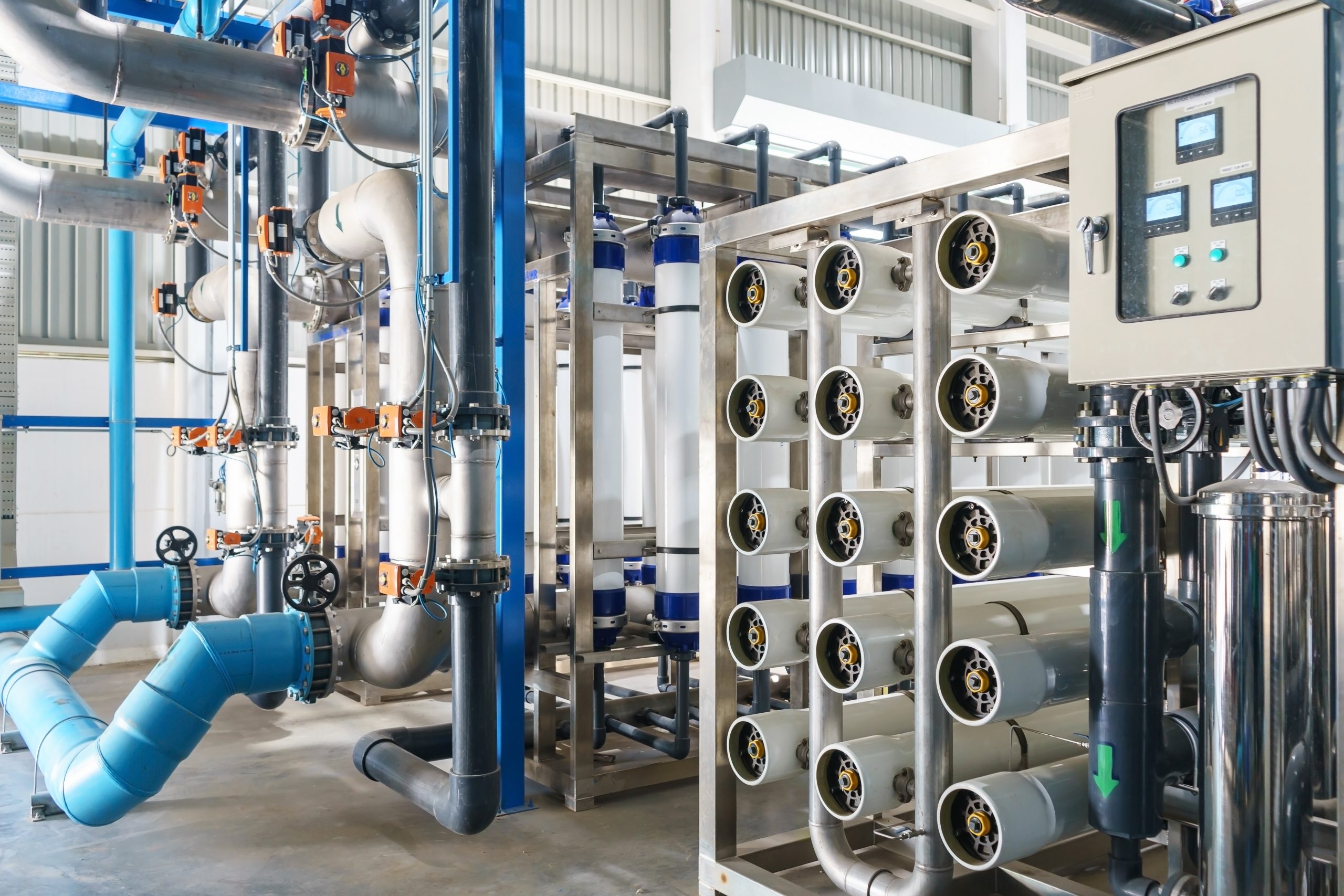
In any steam boiler system the make-up water quality is one of the most important aspects contributing to boiler operation and efficiency. ASME guidelines have long been set to help with standards for water quality to prevent against corrosion, deposition and prevent problems. In a nutshell better quality make-up water means less water, chemical and energy required to make steam.
First, let us look at the basics of a boiler water program and how soft water compared to reverse osmosis (RO) water affect operations. The conductivity of the boiler water is balanced by a probe reading, when the levels are too high water is sent to drain. Make-up water enters the boiler and by dilution the conductivity is lowered. This balance is referred to as cycles of concentration (COC) or concentration ratio. Simply put it is the difference of the total dissolved solids or TDS in the make-up water vs the level in the boiler. The higher the COC results in the least amount of waste.
Soft water make-up from a water softener will remove the calcium and magnesium by the process of ion exchange, the TDS will stay close to the same. While a RO unit will remove up to 98% of the TDS from the water by membrane filtration. This allows for much higher COC. If you were able to obtain a COC of 8 (12.5 % blowdown rate) with soft water you should easily move to a COC of 50 (2% blowdown rate) with RO.
How to Calculate the ROI on an RO System?
Higher quality, lower TDS, water means more potential savings. Everything comes with a cost. As water quality pretreatment improves so does the capital investment with the added maintenance and operational costs. To help weigh the options we have created a calculator to show the potential water, chemical, and energy savings considering all possible factors previously mentioned. When looking at total Boiler HP compared to all the data discussed we can confidently show projected savings and ROI.
The scenario below shows a tremendous savings estimate. Going from a starting Conductivity of 850 to 20 and the how that affects the treatment program.
| | BEFORE | AFTER | SAVINGS | ||||
| Usage & Cost Summary | Units | Annual Usage | Annual Cost | Annual Usage | Annual Cost | Usage | Cost |
| Makeup Water | Lbs | 23,774,162 | $45,171 | 21,764,101 | $41,352 | 2,010,060 | $3,819 |
| Blowdown Water | Lbs | 5,773,725 | $15,531 | 1,027,749 | $2,765 | 4,745,976 | $12,767 |
| Inhibitor | Lbs | 14,446 | $28,892 | 2,571 | $5,143 | 11,874 | $23,749 |
| Oxygen Scavenger | Lbs | 11,200 | $16,800 | 2,098 | $3,146 | 9,102 | $13,654 |
| Return Line Treatment | Lbs | 16,000 | $24,000 | 4,800 | $7,200 | 11,200 | $16,800 |
| Alkalinity Builder | Lbs | 14,446 | $14,446 | 2,571 | $2,571 | 11,874 | $11,874 |
| Makeup Energy | Btu | 20,819,033,346 | $132,721 | 19,058,823,529 | $121,500 | 1,760,209,816 | $11,221 |
| Blowdown Energy | Btu | 13,261,299,363 | $84,541 | 2,360,571,429 | $15,049 | 10,900,727,934 | $69,492 |
| Totals | | | $362,102 | | $198,726 | | $163,376 |
RO water make-up will help maximize your Cycles of Concentration, thereby reducing water, chemicals and energy usage within the boiler. However, RO systems will require more electrical energy and an alkalinity booster chemical. To help determine the benefits and ROI of adding an RO to your boiler treatment system contact Watertech of America and we will put together an assessment for you.

Jon Tiegs
President
Jon has over 20 years experience in the water treatment industry. He has served as an operator of industrial wastewater facilities and sold wastewater equipment. He is currently the President of Watertech and has been with the company since 2008. Jon holds a Bachelor’s of Business Administration from UW-Whitewater.
 Jason Waack
Territory Manager
Jason has over 15 years experience in the water treatment industry. He has been a Territory Manager with Watertech for 5 years, managing accounts in the central part of Wisconsin.

Let’s start with your system.
Because every facility is different, our best insights come from an on-site evaluation. Click below to request a site survey — one of our Technical Engineers will reach out to schedule a visit.